

Loons in the Moonlight
An evening in the Adirondacks

A few weeks ago, my partner Dan and I drove from our home in the Missouri Ozarks to North Hero, Vermont, an island in Lake Champlain, for his cousin’s lovely wedding. It was my first time visiting the Northeast, aside from a short trip to New York City in twelfth grade with my school, and I was ecstatic to meet Dan’s family, but also experience the beautiful woods, lakes and mountains of the Northeast.
We camped in the Adirondack Mountains for two nights: once at a trailhead in the pine woods during a thunderstorm, the cracking thunder and heavy rain hypnotizing us to sleep, shaking rain and pine needles and plucking slugs off our tent the next morning, and once at a campground on Cranberry Lake beneath great beeches and white spruce. We set up camp and swam in the cold lake, which was formed by retreating glaciers and later expanded by the building of dams. I’m not used to a truly sandy lake, as natural lakes are few and far between in Missouri. The lakes I grew up visiting swimming in are all flooded valleys of once great and roaring rivers.
The evening was soundtracked by the songs of Ovenbirds, Red-eyed Vireos, and Cedar Waxwings as we set up camp and swam in the cold, clear lake, sandy from thousands of years of shore erosion, with small, rounded quartz scattered along the beach. We dried in the sun like lizards and then cooked one of our favorite camp dinners, kielbasa and long-grain rice, which always tastes better in the woods than it does in the kitchen at home.
We walked back down to the beach at dusk. The sky turned indigo, as it does at the end of blue hour, and we watched a golden moon rise above the mountains into the cloudless sky, casting a brilliant moonglade, a rippling track of golden light across the water. Party boats thumped distantly as they returned to their docks for the night. When the last of them faded away, the lake became hushed.
I’d been talking the whole trip about how much I wanted to see a Common Loon. I kept getting unlucky because we weren’t on a lake at our first campsite, and they aren’t especially common on Lake Champlain, where we had stayed for the wedding. I asked both the kind person at the Adirondacks Center for Loon Conservation and the state park campground attendant if they had seen or heard any in the area recently. I got excited yeses: there were three breeding pairs across the lake. I still tried not to get my hopes up, since we didn’t have a kayak to paddle out to where they fish, and the lake is the third largest in Adirondack Park.
Earlier that day, I hiked down from our campsite to the shore through pine and beech leaf litter, the delicate wood ferns tickling my ankles, ticks always on the back of my mind despite being coated in a nearly lethal amount of bug spray. The water reflected a lavender sky, the sun beginning to set behind mountains in different shades of purple. I scanned the tree-lined horizon when a black speck caught my eye. I pulled my binoculars to my eyes, and there it was, floating in the distance, unmistakable with its black head and white band around its neck. It was too far away for a decent photograph, but close enough to know that I had finally seen one in the Northeast. Before that, I had only seen a Common Loon once through a friend’s spotting scope at a reservoir near my hometown, where they sometimes spend the winter in their gray winter plumage.
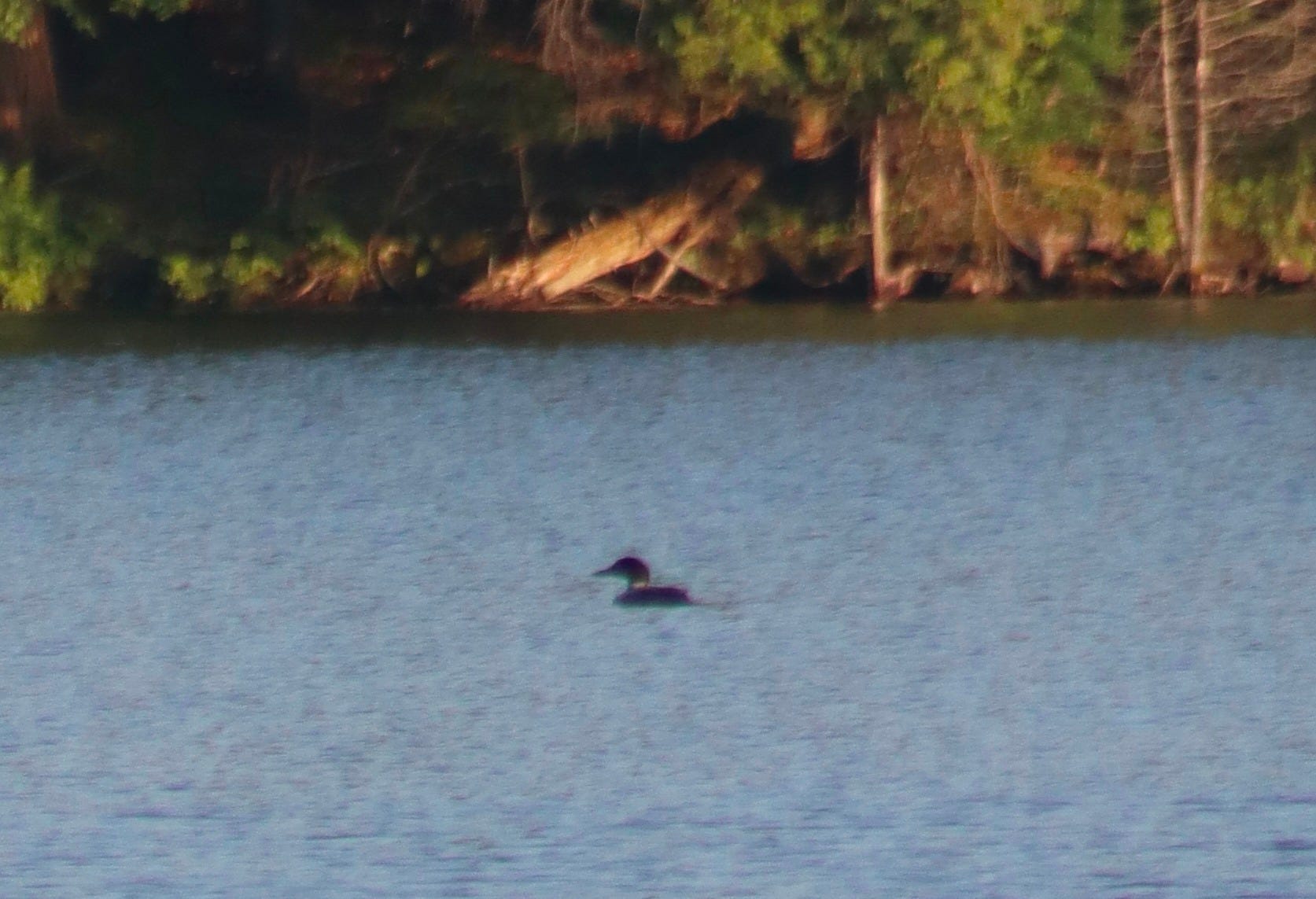
Standing on the quiet lakeshore as the moon rose and the lake grew still, the earth breathing into the night, I whispered to Dan that the only thing that could make the evening more perfect would be hearing the call of a loon. As soon as I finished the sentence, a melancholic wail echoed across the lake. My heart dropped into my stomach as tears sprang to my eyes, one hand coming to my mouth and the other grasping Dan’s arm.
I had heard loon calls countless times in videos online, but hearing one in person was incomparable. Tears welled in my eyes, and Dan wrapped his arm around my shoulders as the calls continued, loons echoing back and forth across the water. The famous wail, then the tremolo, that eerie laughing sound. Dan and I stood holding each other on the sandy shore in the moonlight while waves lapped against the rocks and the trees swayed in the wind. No sounds but the mournful song.
Dan grew up visiting Lake Winnipesaukee with his parents, a natural, spring-fed lake in his dad’s home state of New Hampshire. Dan remembered the songs of loons from those summers of his childhood on its shores. As we listened to the haunting calls, he asked if there were fewer loons now. He remembered a time when many loons called back and forth across the lakes, not just the few we were hearing.
I had to tell him yes. There are fewer loons now. There are fewer of all birds.
Since the 1970s, North America has lost nearly 3 billion birds, a staggering decline of about 29 percent. While the Common Loon is not considered globally endangered, its breeding range has contracted significantly because of habitat destruction. Common Loons once bred and raised their young throughout much of the Midwest, including Iowa, Illinois, Indiana, and Ohio. Today, they are largely restricted to more northern breeding grounds.
Loons are also especially vulnerable to rising temperatures and pollution from coal-burning power plants. As predators, they receive high concentrations of toxins such as mercury, along with other metals released into lakes by acid rain. These contaminants accumulate up the food chain until they reach dangerous levels in loons. Lead poisoning is another major cause of mortality because loons sometimes ingest fishing sinkers while collecting grit. Unsustainable fishing practices and habitat loss from development have also contributed to their decline, as they have for so many other bird species (American Bird Conservancy).
I longed to hear the loons on the moonlit lakes of Dan’s childhood at Lake Winnipesaukee, to be children together standing on the sandy shore, the moon’s silver path stretching across the water, illuminating the mountains rising from the darkness while dozens of loons called to one another through the night. Their voices a prophecy, as though they could foresee what lay ahead, sending mournful warnings across the vast darkness. I wonder how many future generations will know that sound only through recordings, whether, if I choose to have children, they may know such creatures only as mythical stories.
We returned to our campsite by the light of the moon (with some help from a headlamp) and got the campsite ready for bed, falling asleep to the distant calls of loons echoing across the lake.
Video I took of the calls ^