

On Hummingbirds
Mother Nature's crown Jewels

Early in the morning last August, I woke before dawn and went to one of my local nature trails, binoculars and camera in tow. I parked my car as the sun’s rays peeked over the treetops, sending the sky into lighter and lighter shades of blue as it rose, turning the clouds into swirling pink and orange cotton candy. I began my slow, near tiptoe walk, careful not to scare the morning birds.
This particular trail is in lowland forest set along a glittering creek that flows from the mouth of a spring just down the path. The water bubbles up from the deep in sapphire hues, beginning to reflect the colors in the morning sky. Red-winged blackbirds hop from cattails swaying in the early breeze, shouting their ever-present “conk-la-REEEE.” Muskrats swim through the water, and mallards paddle together in the glittering current.
Along the trail, clusters of bright orange jewelweed hum with life. A low vibration fills the air. Flitting from bloom to bloom, the size of cicadas but with the sound of bees. But these are not bugs. They are hummingbirds. Iridescent green and bright red throats catch the dappled morning light, glittering like rubies and emeralds. I am mesmerized, as I always am by the elusive little birds, and I find myself watching them hover and chase each other through the orange blooms until minutes stretch into an hour and a half. An early rain sends me running back to my car to protect my camera, after only getting through the first stretch of the trail.
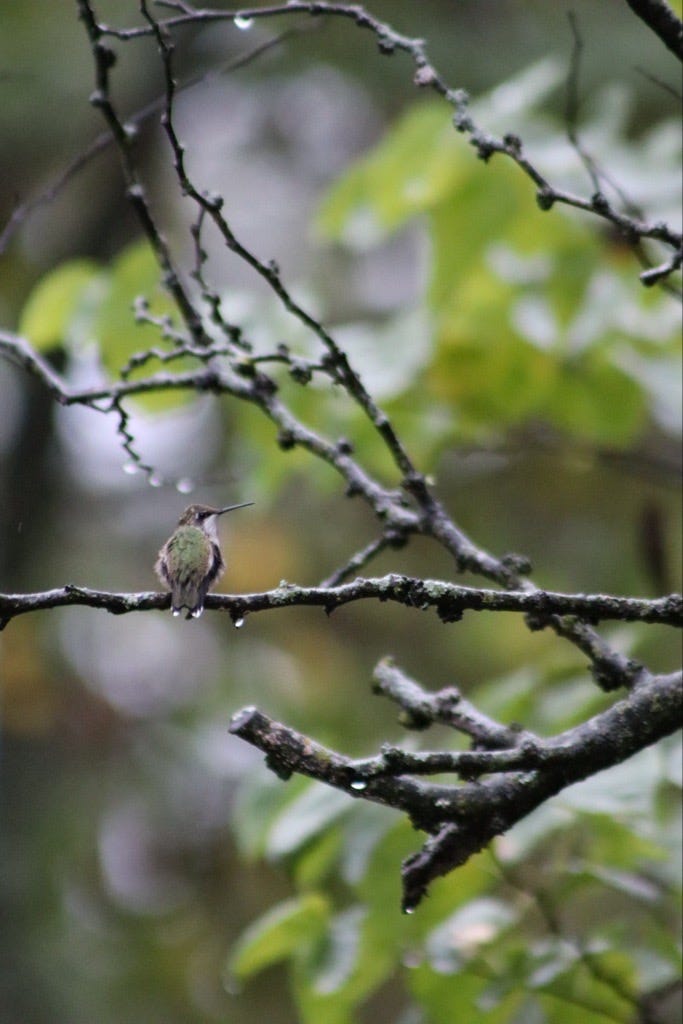
In just a few months, the temperature drops, the daylight shortens, the jewelweed dies off, and the hummingbirds fly south for thousands of miles, alone and guided by instinct. They follow paths they have taken before, traveling up to 23 miles per day as they return to their winter homes in Mexico or Central America.
Of the many species of hummingbirds found in the United States, the ruby-throated hummingbird dominates the Midwest and the eastern states. Black-chinned hummingbirds, more common in southwestern Oklahoma and Texas, prefer more arid conditions than the wetter regions farther east, though occasionally a rare straggler appears in Missouri (Hummingbird Central).
Now it is the first spring in my new home, and I go through the motions of boiling four cups of water and one cup of sugar until it dissolves. I pull my ruby-red feeder from the cabinet, clean it, and fill it a third of the way with the cooled mixture. I hang it on a shepherd’s hook among baskets of rose vervain and red salvia in my front yard, and I wait.
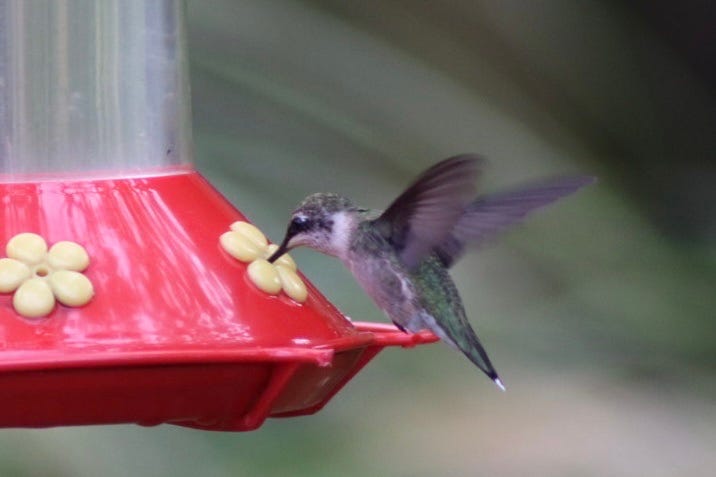
The hummingbird sightings began early this year in mid-March. But it still takes a few weeks of waiting, cleaning, and refilling the feeder before one finally appears, buzzing up to the sugar water. Every year I am surprised by just how small they are, about the length of my pinky finger and weighing three grams.
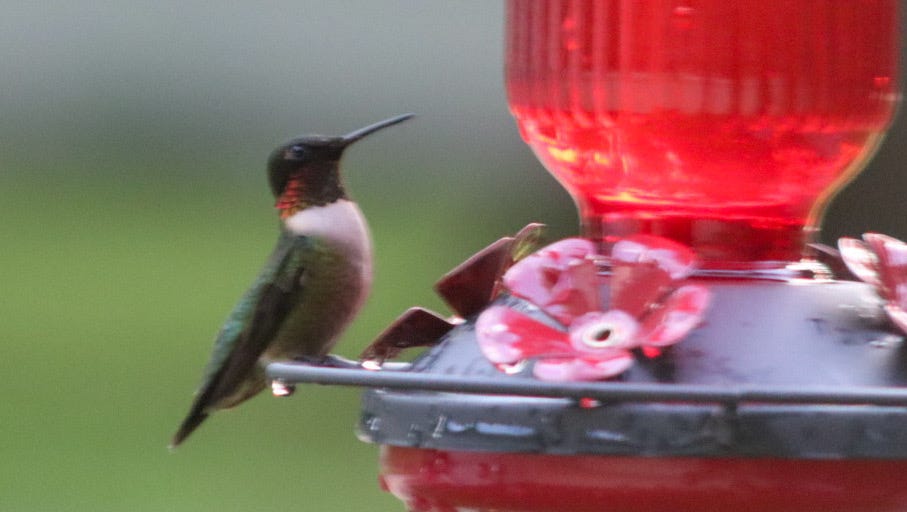
It is hard to believe that something so small, so delicate, and so beautiful can make such a journey twice a year. And yet I get to watch it sit and take sips of the nectar I made for it. Its ruby throat, called a gorget, shifts and shimmers in the changing light, returning multiple times a day, like a small miracle.
Some ruby-throats, especially those that summer in the Northeast and Canada, migrate as far south as Costa Rica. Others make a near 500-mile journey across the Gulf of Mexico without stopping. In preparation, a hummingbird doubles its body mass by consuming nectar and small insects, riding southerly winds and traveling remarkable distances on minimal energy reserves. This is not unique to the ruby-throat. All hummingbirds make this perilous journey (Audubon).
In January 2010, a rufous hummingbird was caught and banded in Tallahassee, Florida. In June of that same year, the same bird was recorded in Chenega Bay, Alaska, a journey of more than 3,500 miles in 6 months. At the time, it was the longest documented migration of a hummingbird (Alaska Fish and Game). I first read about this bird in Jon Dunn’s The Glitter in the Green: In Search of Hummingbirds (2021), and I often find myself thinking of that bird, especially when I make long journeys or dread them.
Not only are hummingbirds beautiful, but they are also endlessly inspiring. They traverse perilous journeys, and still they return, tracing invisible paths across continents and open water, finding their way back to the same blooms, the same feeders, the same yards. This ritual each spring feels like a quiet act of faith, waiting and hoping they will return. And then one day, the hum reaches my ears, brief and electric, a flicker of green and red in the morning light. I am reminded that the world is full of journeys we cannot see, of resilience held in the smallest bodies. It reminds me of the beauty of small things, the importance of tiny miracles, and that even in this world that can be so unforgiving and full of pain, that beautiful things continue to endure.
Easy 3-Step Hummingbird Food Recipe
Mix one part plain white granulated sugar with 4 parts water.
Bring the mixture to a boil.
Wait until the mixture is fully cool before adding to the feeders.
IMPORTANT NOTES / Tips and Tricks
Only use granulated white sugar.
Do not use red dyes, other sugars, honey, etc.
You MUST clean your feeder weekly, or when it’s hot, I suggest every 3-5 days. The sugar water will mold and ferment and make the birds ill.
To make the feeders easier to clean, I make a weekly jar full of food and only fill the feeders a third of the way, I only get 1-2 hummingbirds that feed on my feeder, so in less than a week they barely make a dent in this. I keep the nectar I don’t use in the fridge, but it’s best to only use it in the first for 1-2 weeks.
If you don’t trust yourself to frequently clean your feeder, I suggest planting native plants for the hummingbirds to feed on. Some I have planted are Coral Honeysuckle, Foxglove Beardtongue, and Salvia. They love tubular flowers.
Sources
10 Fun Facts About the Ruby-throated Hummingbird, Audubon
Long-Distance Hummingbird Sheds Light on Migration, Alaska Department of Fish and Game
I really enjoyed this. Such beautiful imagery and thoughts, with some interesting facts sprinkled in!
Loved this. The imagery and the practicality. Thanks for sharing.